


-

৩২৯
THE INSTITUTE OF BANKERS, BANGLADESH (IBB)
Banking Diploma
Examination, July, 2019
DAIBB
Treasury Management(TM)
Time-3 hours
Full marks-100
Pass marks-50
[N.B.—The figures in the right margin indicate full marks. Answer any five questions.]
Marks
1 (a) What does a bank's treasury do? 5
(b) What should be the working strategies. for an efficient treasury department in banks? . 5
(c) What funding and lending strategies would treasury department recommend to the ALCO during the different phases of the business Cycle? 10
2. (a) Describe liquidity risk with example.
(b) How do you manage liquidity risk?
(c) Describe the integrated treasury management system in terms of meaning, functions and structure.
3. (a) What are the responsibilities of the front office, mid office and back office of the treasury department of a bank? 10
(b) How the treasury department of a bank is regarded as a profit center? 10
4 (a) What do you mean: by Real Time Gross Settlement (RTGS) system? Explain the advantages of RTGS used by Bangladesh Bank.
(b) Electronic payments can involve large amounts of money and so require a stringent set of controls- to.mitigate the risk: of loss'—Describe the control mechanism.
5 (a) Give brief explanation of your views.
(b) Discuss in brief the prospects and problems of commodity price hedging in Bangladesh.
6 (a) 'Foreign exchange market also refers to the global market where currencies are traded virtually around the clock' --Explain in brief. 10
b) Define the term 'Swap'. 4
c) Give brief description of various types of swaps. 6
[Please turn over]
7(a) What are the money market instruments in Bangladesh? Give a brief description of each of them. 10
(b) 'The use of derivatives makes fund management easier'-- Explain. 10
8 (a) Mention the auction procedures of Treasury Bills and Bonds in Bangladesh. 10
(b) 'Investment in securities helps liquidity management as well as income stability'—Discuss the statement. 10
9 (a) Describe the sources of funds of a bank. 10
(b) Discuss the factors of loan pricing. 1 0
10. Write short notes of any five of the followings : 4x5=20
Funded and Non-funded loan
a) Cash Management Products
b) Plastic Money
c) Basel III in Bangladesh . •
d) Off.shore Banking unit
e) Caps and Collars
(g) Clean float and Dirty float.
The Institute of Bankers, Bangladesh (IBB)
Banking Diploma Examination November-December 2018
DAIBB
International Trade and Foreign Exchange (FE)


Ka Set
THE INSTITUTE OF BANKERS, BANGLADESH (IBB)
Banking Diploma Examination, July, 2016
DAIBB
Management of Financial Institutions (MFl)
Time-3 hours
Full marks-100
Pass marks- 50
[N.B. The figures in the right margin indicate full marks. Answer any five questions.]
Marks
1 (a) Give an overview of the present situation of Banking sector of Bangladesh.
b) Discuss on 'the role of Central Bank is perfect' as a regulatory body.
c) Does Bangladesh need more banks? Justify your arguments. 5
2. (a) What do you mean by AD ratio? 5
(b) How its changes impact bank's Liquidity and assets management portfolios
(c) What is meant by interest rate spread? 5
3 (a) Explain components of CAMELS Rating. 8
(b) How CAMELS Rating helps to measure financial soundness of a bank?
(c) What is Stress Testing? 4
4(a) What are the causes of nonperforming loans? l0
(b/ What are the impacts of bad loan. on banks profitability? 5
(c) Explain the impact of classified loans on interest rates of banks 5
and financial institutions.
5 (a) What do you mean by Islamic Banking? 5
(b) What are the deposits and loan components of islamic Banking? . l0
(c) Why AD Ratio is different for Islamic Banks? 5
(6 (a) State the main services provided by Agent Banking. 6
(b) What do you mean by e-commerce? 6
(c) What do you mean by interoperatibility of Mobile Financial Services? What might be its benefits?
[Please turn over]
7 (a) what are the credit risk mitigation techniques of a Financial Institution?
(b) How profitability irnpacts banks' capital account
(c) What are the main sources of fund of financial institutions?
8 (a) Discuss the main features of BASEL III.
(b) Write the importance of loan securitization.
(c) Discuss loan classification and its provisioning.
9 (a) what are the major financial statements prepared by a commercial bank? Describe the purposes of preparing each statement.
(b) Define money laundering and its steps.
(c) Describe :
(i) IP and PEPS;
(ii) KYC and KYE;
(iii) EDDI
(iv) Beneficiary Owners.
10. Write short notes (any eight):- 20
(a) Crypto currency;
(b) NPSB;
(c) Off-shore Banking
(d) SMS Banking;
(e) Trade Base Money Laundering
(f) Insurable interest;
(g) Market Risk;
(h) Shell Bank
(i)Collateral Security:
(j) Core Capital;
(k) BFIU;
(l) Option.
[ibb-diploma.blogspot.com]
 |
DAIBB Central Banking & Monetary Policy (CMP) question 2016
|
THE INSTITUTE OF BANKERS, BANGLADESH (IBB)
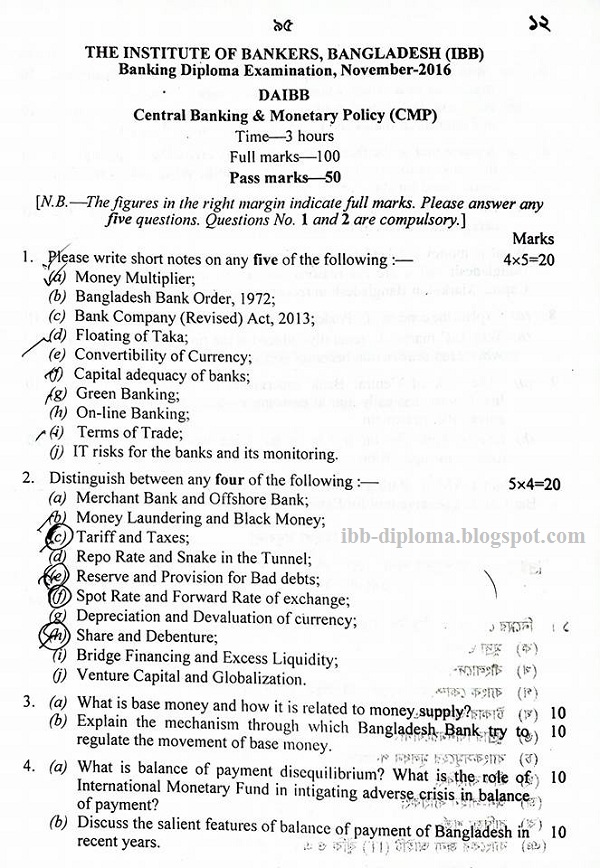
Banking Diploma Examination, November-2016
Banking Diploma Examination, November-2016
DAIBB
Central Banking & Monetary Policy (CMP)
Time--3 hours
Full marks-100
Pass marks-50
[N.B. -- The figures in the right margin indicate full marks. Please answer any five questions. Question No. 1 and 2 are compulsory.]
Marks
1. Please write short notes on any five of the following :— 4x5.20
a) Money Multiplier;
(b) Bangladesh Bank Order, 1972;
(c) Bank Company (Revised) Act, 2013;
(d) Floating of Taka;
(e) Convertibility of Currency;
(f) Capital adequacy of banks;
(g) Green Banking;
(h) On-line Banking;
(i) Terms of Trade;
(j) IT risks for the banks and its monitoring.
2. Distinguish between any four of the following :— 5X4=20
(a) Merchant Bank and Offshore Bank;
(b) Money Laundering and Black Money;
(c) Tariff and Taxes;
(d) Repo Rate and Snake in the Tunnel;
(e) Reserve and Provision for Bad deb.;
(f) Spot Rate and Forward Rate of exchange;
(g) Depreciation and Devaluation of currency;
(h)Share and Debenture;
(i) Bridge Financing and Excess Liquidity;
(j) Venture Capital and Globalization.
3. (a) What is base money and how it is related to money.supply? 10
(b) Explain the mechanism through which Bangladesh Bank try to regulate the movement of base money. 10
4. (a) What is balance of payment disequilibrium? What is the role of International Monetary Fund in intigating adverse crisis in balance of payment?
(b) Discuss the salient features of balance of payment of Bangladesh in recent years. 10
5. (a) "Risk management is very important for banks and financial institutions to continue its activities while maximizing profits"— Discuss. 10
(b) How does Bangladesh Bank try to ensure internal control mechanism of Commercial Banks and Financial Institutions in Bangladesh? 10
6. (a) Assume that in the face of severe liquidity crisis, the competition of the banks is forcing the deposit rate upwards. What actions you will recommend for Bangladesh Bank to take? 10
(b) Do you think that your recommendation will not hamper the deregulation effect of the financial sector? Why? 10
7. What is money market? Discuss the present state of Capital Market in Bangladesh. What are the reasons behind the frequent fluctuations in Capital Market in Bangladesh in recent years? 20
8. (a) Explain the concept of "Prudential Regulation". Why these are issued? 10
(b) Why L/C margin is generally reduced at the time of severe inflation 10 when credit restriction becomes necessary?
(b) Why L/C margin is generally reduced at the time of severe inflation 10 when credit restriction becomes necessary?
9. (a) "The task of Central Bank supervision of banks and Financial Institutions, basically aim at ensuring market discipline."—Do you agree? Please explain. 10
(b) Briefly highlight on the basic guideline that Bangladesh Bank follows in supervision activities. 10
10. Explain CAMEL Rating System. How it can be used by Bangladesh Bank as an effective tool for Bank Supervision. 10
If you love this post, share with your friends.

Ka Set
THE INSTITUTE OF BANKERS, BANGLADESH (IBB)
Banking Diploma Examination, July 2018
DAIBB
International Trade and Foreign Exchange (FE)
Time-3 hours
Full marks-100
Pass marks-50
(N. B. --The figures in the right hand margin indicate full marks. Answer any
four questions from group A and one question from group B.]
Group A
1. Write short notes on any of the following':-(a) Brexit:
(b) Reimbursing bank;
(c) Dhaka Inter-bank Offered Rate (DIBOR);
(d) International Development Association (IDA);
(e) Export Development Fund;
(f) Cross Rate:
(g) Foreign Correspondents.
3. What are the main factors responsible for declining trend of remittances from overseas Bangladesh nationals? Please offer your suggestions to improve the trend.
4. What is standby letter of Credit? Why such credits are used? Distinguish between standby credit and ordinary documentary credit.
5. For some years now the balance of trade of Bangladesh is declining quite fast? What are the causes that can be attributed in this declining trade? How this trend can be reversed?
6. Discuss the causes for transfer of money from Bangladesh to foreign countries. What the authorities can do to steps the leakage of foreign exchange on this account?
7 What is off-shore banking? How does it helps the entrepreneurs in Bangladesh to meet their foreign exchange needs, specially to operate industrial enterprises in the export processing zones?
8. Briefly distinguish between the following terms:
(a) Letter of Credit and Back to Back LC;
(b) FDBP and LDBP;
(c) Current account and Capital account:
(d) Balance of Trade and Balance of Payments;
(e) Airway bill and Air consignment note.
Group B
9. The current market exchange rates are as follows:-
£1 = $ 1.3947-1.3957
$ 1 = Tk. 82.9020 - 82.9820
Please calculate the exchange rate of your bank for buying 120 days pound sterling usance bill assuming the following:
Transit period 10 days
Rate of interest 10% per annum
Profit margin Tk. 0.10 per pound sterling
One year = 360 days
Rough calculations to be shown.
10. You have $1,00,000 at your disposal Based on the following data where would you prefer to invest your fund to maximize your return on the investment for a period of 3 months?
(a) US $ 1= 82.9020 - 82.9820
(b) 3 months forward margin Tk. 0.0153 0.0165 (premium)
(c) Interest rate at Dhaka 10% and 5% per annum in New York. Assume 360 days as one year.

Ka Set
THE INSTITUTE OF BANKERS, BANGLADESH (IBB)
Banking Diploma Examination, July, 2018
DAIBB
Management Accounting (MA)
Time-3 hours and 30 minutes
Fun marks---100
Pass marks-50
[N. B.-The figures in the right margin indicate full marks. Answer any five questions. Different parts of a question should be answered in a same place. Use of calculator is permissible. ]
Mark
1. (a) Discuss briefly the role of Management Accounting in planning, control and decision making a in bank with examples relevant to your answer. 7(c) Distinguish between Management Accounting and Financial Accounting. 6
2. (a) Discuss the difference between Product Cost and Period Cost. 5
| Inventories | January-l | Deccmbcr-31 |
| Finished goods | 350 units | 450 units |
| Work in process | Tk. 90,000 | Tk. 45,000 |
| Raw material’s | Tk. 35,000 | Tk. 50,000 |
| Finished goods unit cost | 162 | ? |
| Depreciation : | ||
| Office equipment | 2800 | |
| Factory plant and Machinery | 21500 | |
| Vehicle engaged for marketing | 3200 | |
| Maintains : Generation machine | 9500 | |
| Factory building | 5200 | |
| Internal roads and drain | 10000 | |
| Sales @ Tk. 220 per unit | 8,53,600 | |
| Income Tax paid | 5000 | |
| Miscellaneous expenses and cost : | ||
| Fuel (gas bill) | 4500 | |
| Telephone factory | 6000 | |
| Power for light (90% for factory, 10% for administration) | 3000 | |
| Water | 4000 | |
| Land, rates and taxes (80% factory, 20% office) | 4300 | |
| Indirect materials | 2645 | |
| Raw materials purchase | 3,64,000 | |
| Direct labour | 1,62,500 | |
| Wages paid to worker which there was no production due to power failure. | 17000 | |
| Leave and bonus | 40000 | |
| Factory office expenses : | ||
| Factory foreman salary ‘ . | 6000 | |
| Factory manager salary | 16000 | |
| Truck, hire cost to carry purchased materials | 8000 | |
| Purchase discount | 5200 | |
| Marketing expenses | 20000 | |
| Administration expenses | 15000 | |
| Interest earned (aher tax deduction) . | 6000 |
(i) Statement of cost of goods sold. 8
(ii) Income statement showing gross and net profit in total and per unit. 7
(c) Following is the cost statement of ABC Company :10
| Raw materials | T k. 50 per unit |
| Direct labour cost | Tk. 20 per unit |
| Overheads cost | Tk. 40 per unit |
| Total cost | Tk. 10 per unit |
| Profit | Tk. 30 per unit |
| Selling price | Tk. 140 er unit |
(i) Average Raw material, in stock . One month
(ii) Average Raw materials in process Half a month
(iii) Stock of finished goods 30 days
(iv) 20% sales are cash sales . .
(v) Expected cash balance Tk. 1,00,000
(vi) Credit allowed to debtors Two months
(vii) Credit allowed by creditors 45 days
(viii) Time lag in payment of wages 15 days
(ix) Time lag in payment of overhead 1 month
(Note: 360 days in a year)
You are required to prepare statement showing the working capital requirement if level of activity of the company is 70,000 units. Assume 360 days In a year.
| Year | Cash benefits (in taka) |
| 1 | 500000 |
| 2 | 10,00,000 |
| 3 | 8,00,000 |
| 4 | 10,00,000 |
| 5 | 5,00,000 |
| 6 | 6,00,000 |
Required :
(i) Payback period.
(ii) Average Annual Rate of Return (ARR).
(iii) Net Present Value (NPV).
(iv) Present value of payback period.
(v) Profitability Index (131)
(vi) Comment on financial viability of buying the machine.
(The present values of Tk. 1 for six years at 10% are : 0.909, 0.826, 0.751, 0.683, 0.621, 0.564)
| Per pair | Taka |
| Selling price | 30.00 |
| Variable cost | 19.50 |
| Salesmen’s commission | 1.50 |
| Total variable cost | 21.00 |
| Annual fixed expenses are :- | |
| Rent | 60,000 |
| Salaries | 2,00,000 |
| Advertising | 80,000 |
| Other fixed expenses | 20,000 |
| Total | 3,60,000 |
(i) Calculate the annual break-even point in units and in taka sales. Also determine the profit or loss if 45,000 pairs of shoes are sold.
(ii) The sales commissions are proposed to be discontinued, but instead a fixed amount of Tk. 54.000 is to be incurred in fixed salaries. A reduction in selling price of 5% is also proposed. What will be the Break-even point in unit and in taka sales?
(iii) It is proposed to pay the store manager 50 paisa per pair as additional commission. The selling price is also proposed to be increased by l0%. What would be the Break-even point in units and in sales taka?
(iv) Refer to the original data. If the store manager were to be paid 30 paisa (Tk. 0-30) commission on each pair of shoes sold in excess of the Break-even point. What would be store‘s net profit, if 50,000 pairs were sold?
(v) Determine the point of indifference between commission plan and salary plan.
(Note: Consider each part of the question separately.)
(b) What are the assumptions underlying in construction of a Break-even chart? 4
(c) “The effect of a price rise is always to increase the p/v ratio and to get reduced the Break-even point.” Explain the statement with example.
| Taka | |
| Cost of acquiring additional land for runway | 7,000,000 |
| Cost of runway construction | 20,000,000 |
| Cost of extending perimeter fence | 2,984,000 |
| Cost of runway lights | 3,960,000 |
| Annual cost of maintenance of new runway | 2,800,000 |
| Annual incremental revenue from landing fees | 4,000,000 |
Required:
(a) Compute the initial cost of the investment in the long runway.
(b) Compute the annual cost or benefit from the runway.
(c) Prepare a net present value analysis of the proposed long runway.
(d) Should the Board representatives approve the runway?
- The financial statements of LLM Company are presented below :
LLM Company
Income Statement
for the year ended December 31, 2017
| Particulars | Amount |
Amount
|
| Taka |
Taka
| |
| Net Sales (All on account) |
6.00.000
| |
| Less : Cost of goods sold |
4.50.000
| |
| Gross profit |
1,50,000
| |
| Less : Operating expenses : Selling expenses | 60,000 | |
| Administrative expenses | 25,000 | |
| Total operating expenses |
85,000
| |
| Net operating income |
65,000
| |
| Less: Interest expenses |
5000
| |
| Income before tax |
60,000
| |
| Less: Income Tax expenses |
17,500
| |
| Net Income |
42,500
|
Comparative Balance Sheet
on 31st December
| Assets : | 2014 |
2016
|
| Taka |
Taka
| |
| Cash | 60.000 | 32,500 |
| Accounts Receivable(Net) | 50,000 | 35,000 |
| Merchandise Inventories | 95,000 | 87,500 |
| Land | 75.000 | - |
| Property, Plant and Equipment | 1,75,000 | 1,95,000 |
| Accumulated Depreciation | 75,000 | 60,000 |
| Total Assets | 3,80,000 | 2,90,000 |
| Liabilities and Stockholder’s Equity : | - | |
| Accounts Payable | 65,000 | 82,500 |
| Income Taxes Payable | 37,500 | 50,000 |
| Notes Payable | 50,000 | 25,000 |
| Bond Common Share | 75,000 62,500 | - 62,500 |
| Retained camings | 90,000 | 70,000 |
| Total Liabilities and Stockholder’s Equity | 3,80,000 | 290,000 |
Additional Information:
(a) During the year Plant and Equipment was sold for Tk. 25,000 cash.
(b) The original costs of the assets were Tk. 37,500 and has a book value of Tk. 25,000 at time of sale.
(c) Dividend of Tk. 25,000 were declared and paid.
(d) Depreciation expenses altogether Tk. 27,500.
(e) Additional equipment was purchased for Tk. 17,500.
(f) In the year of 2017 LLM Company issued Bond to purchase land. These Bonds were exchanged with the land owner.
Required:
(i) Prepare a statement of Cash Flow for 2017, under the direct method.
(ii) Prepare a statement of Cash 1" low for 2017, under the indirect method.
- (a) What is profitability? How can a firm improve the profitability of a project? 5
| Product (A) | Product (B) | |
| Units products and sold | 600 units | 500 units |
| Taka | Taka | |
| Direct Materials (per unit) | 2.00 | 4.00 |
| Direct Labour (per unit) | 4.00 | 4.00 |
| Factory overhead per unit (40% iixcd) | 5.00 | 3.00 |
| Selling and administrative overhead (60% fixed) | 8.00 | 5.00 |
| Total cost per unit | 19.00 | 16.00 |
| Selling price per unit | 23.00 | 19.00 |
Factory overheads are absorbed on the basis of machine hours which is the limiting (key) factor. The machine hour rate is Tk. 2 per hour. The company receives an offer from China for the purchase of product ‘A‘ at a price of Tk. 17-50 per unit. Alternatively, the company has another offer from Iran for purchase of product B at a price of Tk. 15-50 per unit. In both case a special packing charge 0f Tk. 0.50 per unit has to be borne by the company. The company can accept either of the two export orders and in both the case the company can supply such quantities as may be possible by utilizing the balance 0f 25% 0f its capacity.
You are required to prepare:--
(i) A statement showing the economics of the two export proposals giving your recommendations as to which proposal should be accepted.
(ii) A statement showing the overall profitability of the company after incorporating the export proposal recommended by you.
Purchase: If the firm purchases the machine, its cost of Tk. 80.000 will be financed with a 5 year. 14% loan requiring equal end-of-year payments of Tk. 23,302. The machine will be depreciated under straight line method, assuming zero salvage value. The firm will pay Tk. 2.000 per year for a service contract that covers all maintenance costs; insurance and other costs will be borne by the firm. The firm plans to keep the equipment and use it beyond its 5 year recovery period.
Required:
(a) Determine the after-tax cash outflows of MML under each alternative. 8
(b) Find the present value of each after-tax cash outflow stream, using the after-tax cost of debt. 8
(c) Which alternative lease or purchase--would you recommend? Why? 4
(b) Cost of capital and financial leverage;
(c) Budgetary control systems;
(d) Management report;
(e) Variance analysis;
(f) Inventory management;
(g) Hire purchase finance;
(h) Receivables management.
Ka Set
THE INSTITUTE OF BANKERS, BANGLADESH (IBB)
Banking Diploma Examination, July, 2018 DAlBB Lending Operation & Risk Management.(LRM)
Time-3 hours Full marks--100
Pass marks-50
[N.B.-AII questions carry equal marks. Answer any five questions. Diferent parts of a question should be answered in a same place]
1.(a) What is creditworthiness? Discuss the points those are essentially to be considered by a banker while assessing the creditworthiness of a perspective borrower.
(b) State how will you deal with existing borrower needing enhancement of the creditability.
2. (a) Define the SME credit in the light of Bangladesh Bank’s guidelines and mention the booster sector.
(b) Bangladesh Bank has of late made some changes as regards provisioning on SME loans, but some banks are reported to have been measuring the revised concept through unfair convension of some other loans to SME loans. Give your opinion on the matter. How to relief to this unfair Situation? Please suggest.
3. (a) Distinguish between Lending Risk Analysis (LRA) and Credit Risk Grading (CRG). Write down the expected CRG requirement for extending credit.
(b) Explain the risk factors that make an industry sick. How would you proceed to consider rehabilitation needed of a sick project?
4. (a) Define portfolio management. Highlight the role of responsibility of Branch Manager in respect of borrower selection and loan processing.
(b) What will you do when a loan proposal does not fall within set criteria of approved credit policy but the applicant affears to be potential and helpful for the bank’s branch?
5. (a) Define ALCO and its formation structure. Discuss the role and responsibility of ALCO for profer leading of a bank.
(17) Do you think that the absence of asset liability management in the bank may cause damage to its image and foundation? Elaborate your answer.
(a). Define Green banking as per Bangladesh Bank’s guidelines Discuss the importance and need of green banking in the context of present and future global warming situation of the country
(b) Briefly give a resume of green banking activity of your bank/institution
(a) What is provisioning? Discuss the basis of determining the status of classified loans and advances.
(b) Is it due to the increase of classified loans of the bank that they now facing liquidity problems and borrow interbank call money at very high rate? Justify the view. If you areagreed or not agree- comment.
(a) What do you mean by a project and its app1aisal? During appraisal of a project loan proposal what factors does a banker take into consideration? Please explain.
(b) Mr. Ahmed Ali an enterprise of your branch area has applied for a loan of Tk. 20,00,000 to establish a nursery project (to ensure green banking) to your branch. Please write an appraisal report of the banks loan proposal explaining the following points -
(i) About the applicant
(ii) About the enterprise (nursery)
(iii)About the security, calculating maximum credit Limit (MCL)
(iv) About the credit needs ,
(v) About the income and expenses ie. profitability
(Vi) About marketing
(Vii) Recommend loan amount considering the above analysis.
9. (a) Banks usually extend credit against securities. Please list down the different types of securities against which Banks sanction loans to its c1ient. Discuss their advantages & disadvantages in brief.
(b) In selecting a borrower, if it is perfectly made, “Loan cannot term into bad”. Elaborate your comment on this statement.
Write short notes on five of the following: -
a) Debt: Equity Ratio;
(b) .Bankers Book Evidence Act;
(C) MicroCredit Regulatory Authority (MRA);
d) CAMELS Rating;
e) Sensitivity Analysis for a p1oject loan Appraisal;
f) Bill of lading
g) Single Borrower exposure
h) G.S.P
Institute of Bankers Bangladesh
DAIBB
Management Accounting Question December 2017 (Re-exam)


THE INSTITUTE OF BANKERS, BANGLADESH (IBB)
Banking Diploma Examination, November-2016
DAIBB
Central Banking & Monetary Policy (CMP)
Time--3 hours
Full marks-100
Pass marks-50
[N.B.—The figures in the right margin indicate full mark. Please answer any five questions. Question No. 1 and 2 are compulsory]Marks
1. Please write short notes on any five of the following :— 4x5=20
(a) Money Multiplier;
(b) Bangladesh Bank Order, 1972;
(c) Bank Company (Revised) Act, 2013;
(d) Floating of Taka;
(e) Convertibility of Currency;
(f) Capital adequacy of banks;
(g) Green Banking;
(h) On-line Banking;
(i) Terms of Trade;
(j) IT risks for the banks and its monitoring.
2. Distinguish between any four of the following :— 5X4=20
(a) Merchant Bank and Offshore Bank;
(b) Money Laundering and Black Money; (c)Tariff and Taxes;
(d) Repo Rate and Snake in the Tunnel;
(e) Reserve and Provision for Bad deb.;
(f) Spot Rate and Forward Rate of exchange;
(g) Depreciation and Devaluation of currency;
(h) Share and Debenture;
(i) Bridge Financing and Excess Liquidity;
(j) Venture Capital and Globalization.
3. (a) What is base money and how it is related to money supply? 10
(b) Explain the mechanism through which Bangladesh Bank try to regulate the movement of base money.
4. (a) Who is balance of payment disequilibrium? What is the role of International Monetary Fund in intigating adverse crisis in balance of payment?
(b) Discuss the salient features of balance of payment of Bangladesh in recent years.

THE INSTITUTE OF
BANKERS, BANGLADESH
Banking Diploma Examination, November, 2017
JAIBB/DAIBB
International Trade & Foreign Exchange (FE)
Time- 3 hours
Full marks-- -100
Pass marks-50
[N. B. The figures in the right margin indicate full marks.
Answer any four questions from group A and one question from group B
Group A
Write short notes on any five of the following:—
a) Brexit;
(b) Combined Bill of Landing;
(c) Foreign Exchange Regulations in Bangladesh;
d) Consular Invoice;
e) Bill of Entry;
f) Packing Credit;
g) Asian Development
Bank.
2. Briefly describe the types of credit facilities offered
by the banks to their clients engaged in import trade. Identify the risks
associated with import financing and the ways these risks can be minimized.
3. Describe
the mechanisms for receiving payments against exports 5x4=
20
from Bangladesh under the following arrangements:-
(a) Letter of Credit;
(b) Bills for collection; (c) Consignment Sale; (d) Advance payment.
4. How does
a transferable letter of credit operate? Describe the 10+ I0=20
obligations and rights of the negotiating hank under this
type of credit.
5. Flight of
capital from Bangladesh to Switzerland and other 10+ 10= 20
centres is a matter of serious concern liar Bangladesh. What
are the likely causes for this phenomenon? What are your suggestions to stop
the capital flight?
6. Describe
the main features of foreign exchange market in 12+ 8=20
Bangladesh. Offer your suggestions to make the market more
meaningful to meet the needs of the banks and clients for both spot and forward
transactions.
7. What kind
of exchange rate policy is being currently followed by the authorities in
Bangladesh? Do you think Bangladesh taka should be devalued to improve export
performance and the flow of remittances from our nationals working
abroad?
8. Trace the
effects of smuggling of goods across Indo Bangla 10+
10 =20
border. What measures can be taken to curb this trend?
Group B
9. Please calculate the selling exchange rate of your bank
for Euro using the following data :--
Euro 1 =USD 1.1742-1.1642
US$ 1 = Tk. 78.5030-78 7070
Your margin of profit per Euro—1/ 8 %
SWIFT charges — 1/12 % per Euro.
10. Please calculate the exchange rate for buying a 120 day
bill 20
denominated in pound sterling using the following parameters
£ 1 = $ 1.4947 - 1.4957
$ 1 = Tk. 78.9020-78.10
Transit period 10 days
Interest rate 10% p.a
Profit margin per pound sterling Tk. 0.10


